Sunday, July 14, 2013

A Learned Ignorance

Officially, I have two unfinished written pieces - completely unrelated - and am in the middle of reading five books.  Yeah, I have no idea why I can't get to an outcome with anything either.  It is SUCH a mystery.  You'd think Liv and I would have been with Daphne and Velma this weekend instead of Tammy and Maddy...

So anyway, as I started to type and feign concern for my about-to-add-to-the-ongoing-adjectives-and-ailment-list, I remembered.  I remembered a paper I had written, in the most difficult class and graded by the most difficult professor (Read: A-, whatever.) The Autobiographical Statement and Bible Exam were actually my two favorite assignments, because they did not involve any extreme challenges, making it impossible for me to totally lose my cool in a grading situation from an excess of competitive fervor.

And in that I don't have the wherewithal right now to either read or write, here it is.  A paper which answers a very important question.


Philosophy of Religion


The Problem of Evil

This seminar paper will reflect upon the problem of evil as a case against the existence of God.  While it may seem too beautiful a fall day to spoil with talk of evil, it is necessary for ongoing education in philosophy to face its reality as we continue to be surrounded by evil people and evil situations daily.

1.     The Hidden God 

One obvious challenge to ethical monotheism is the question of evil, or “the hidden God.”  Why doesn’t God just make God’s existence known in some definitive and spectacular way?  For instance, it would be a great deal easier for people to believe in God if He/She/It would simply deposit a billion dollars in a Swiss bank account in their name, or perhaps save them from some active and immediate peril, right?
 
Jesus once commented upon the apparent indifference of heaven to affairs of the earth when he observed, “the rain falls on the just and the unjust alike.”[1]  We should not, in other words, read too much into the significance of a drought or a flood.  Such things just seem to happen, and happen without any moral meaning.  This is consistent with the understanding of faith as arriving at its convictions based upon “things not seen.”[2]  Faith does not depend upon sight, and in the case of evil, it must operate despite sight. 

The ancient Greeks understood this mystery as well and erected a statue in the agora of Athens dedicated to “the unknown God.”  This became the basis for a sermon given by St. Paul to the skeptical philosophical crowd of Athens.[3]  And some think that in direct response to this sermonic attempt, St. Paul later wrote of God’s deliberate plan to “hide” the gospel from the wise of this world in the apparent weakness and foolishness of a crucified Christ.   

Luther made much of the distinction between the “hiddenness” of God, the Deus Absconditus, and the revealed God of Scripture.  He contrasted the hidden God with the revealed God and insisted that our knowledge of God must begin always with the revealed God within history and not from speculations arising out of the mystery surrounding the hidden God within history.  Despite all appearances to the contrary, we must trust God’s revelation even when, and especially when, history appears indifferent to our welfare.    

But the category of history as an arena of God’s providence certainly suffers as a result of this.  So much so that Luther speaks of history as merely God’s “sport,” and Shakespeare makes this even more pointed by saying of history that it is: “a tale, told by an idiot, full of sound and fury, signifying nothing.”[4]
 
For classical theists, Jews, Christians and Muslims, the problem of the contradiction between the world as it ought to be and the world as it is, between the revealed will of God and the hidden will of God, must be addressed and an answer of some kind offered.   

2.     The Skeptic’s Challenge 

David Hume would phrase the challenge in this way: “Is God willing but unable?  Then God is impotent.  Is God able but unwilling?  Then God is malevolent.”  Thus he argues that God cannot be both omnipotent and beneficent at the same time.   

In its most succinct form, it can be stated as follows:  

“If God is “GOD,” then He is malevolent.

If God is “GOOD,” then He is impotent.

Otherwise, when cometh evil?” 

Similarly, the skeptic can turn the teleological argument for God’s existence on its head.  For instance, if God is the great designer of the world and the world supposedly then reflects His “order” and “purpose,” then does not the reality of evil represent a considerable fly in the ointment?  Is it not an insurmountable obstacle to belief in divine providence when God’s providence appears sublimely indifferent and callous to the moral problem of evil in history?  What kind of divine teleology can possibly justify such historical carnage? 

Does the character of such a dysteleological world reveal something of the character of God?  Given the way the world is, what must its designer be like?  We could even frame the question as a “product liability suit.”  Since we hold human manufacturers liable for their hazardous products, why not hold God liable?

This very complaint is brought forcibly home in Dostoevsky’s The Brothers Karamazov where Ivan tells his brother Alyosha “I do not accept God’s world,” because it is a world in which innocents must suffer.  Ivan then relates the story of a general who uses hounds to hunt down and tear to pieces an innocent boy, a serf.  He then asks Alyosha what should be done to such a man.  Alyosha says softly, “Shoot him.”  Thus, Ivan and Alyosha agree, one who knowingly permits the suffering of innocent children deserves to be shot.  Thus, Ivan and Alyosha agree:  any being, human or divine, who knowingly permits the suffering of innocent children deserves to be shot.  Isn’t God just such a being?!  This is the protest of moral atheism. 

Thus, the problem of evil represents the most compelling argument against ethical monotheism’s concept of an all-powerful and all good God.  This is more than just an existential problem, though it is certainly that.  It must be taken seriously as an intellectual challenge to consistent theism. 

Our text takes up the problem of evil on two fronts, as a logical problem and as an evidential problem.

1.     The Logical Problem of Evil

As a logical problem, it is asserted that the existence of God is logically inconsistent with the existence of evil.  It is logically impossible for an omniscient and omnipotent good being to continence evil.  Evil’s existence is not necessary. 

But Alvin Plantinga argues in his Free Will Defense that human freedom necessarily entails the possibility of evil.  Evil is a necessary corollary to human freedom.  You can’t have one without the other.  God can only forestall the occurrence of moral evil by excising the possibility of moral goodness.   

But why cannot God create free creatures who always do what is right, whose moral character is fixed?  Plantinga argues that freedom requires a real ability to choose otherwise, i.e., an objective choice must exist.  This is the incompatibilist view of freedom, namely that freedom is incompatible with determinism.  God cannot determine the actions of free persons.   

But others argue for a compatibilist view of freedom, that freedom and determinism are not in conflict.  Freedom does not require the actual ability to choose otherwise, but only a subjective perception of choice must exist.  So, even if we really cannot do otherwise, so long as we believe that a real choice lies before us, we are free, even if all of our choices are predetermined to be good choices.  
 
Plantinga responds by arguing that significant (i.e., not trivial) moral freedom be defined as follows:  “A person is free with respect to an action A at a time t only if no causal laws and antecedents conditions determine either that he performs A at t or that he refrains from so doing.”  If that is the case with freedom, then morally significant freedom is not compatible with any form of determinism.

So, it was not a fundamental error for God to create free creatures, creatures free to sin, free to rebel, free to despair, free to turn against God.  Otherwise God would have created creatures so determine in their moral character that they cannot rebel, so that they can only choose the good, the true and the beautiful.  And if that were the case, then what kind of a world would result?  What kind of creatures would we be?  Is the choice between being a rebel or a robot?  

John Locke states that God puts us into a world in which the challenges of life, including evil, exist because God is good.  If God had placed us in an antiseptic and anesthetic world without pain, if God were to hand us all we need and preserve us from any dire consequences of our own choices, then we would lack all incentive to cultivate our mind and talent.  We would, so to speak, live like pigs and just contentedly wallow in the muck.  Without pain and suffering, in other words, mankind “would be a very idle, inactive creature, and pass his time only in a lazy lethargic dream.” 

Socrates made a similar point in Plato’s Symposium.  Since only the gods are wise and have everything they need, we humans are necessarily erotic and needy creatures, longing for wisdom and plenty.  And because we lack perfection, we must, therefore, strive for it.  Thus, philosophers both ancient and modern have understood that suffering is part of the price we pay for freedom and as a goad to human excellence.
 
In fact, wealthy societies tend to be at grave risk of becoming soft, of degenerating because things are too easy.  In this respect, soft times are hard times.  This is not to romanticize evil as really something intrinsically good, or to become positively giddy about human suffering and pain.  But it is to put evil into a coherent metaphysical context.  And because suffering and evil can never be abolished, this helps to mitigate and curb, to confine evil and suffering to more bearable proportions. 

2.     The Evidential Problem of Evil 

While Plantinga’s Free Will Defense may withstand logical arguments about the incompatibility of belief in God and evil, others argue that belief in God is implausible given the facts of evil.  Here the challenge is to square belief in a good God with the evidence of evil in the world and history.  It may be logically possible for God to exist, but is it plausible given the actual state of affairs as we know it? 

Statistically speaking, given the amount of evil present in the world, is this the kind of world one would antecedently expect from a being who is extremely intelligent, benevolent and powerful?  But such an inductive approach to the question of evil would require an alternative world with which to statistically compare, of which we have none.  And the worlds we otherwise create for ourselves as theoretical models, are mere caricatures, and defined by our own presuppositions which thus prejudice the experiment.

To use the prima facie evidence of evil as an argument against the existence of God is to treat theism as a kind of large-scale metaphysical hypothesis for which we anticipate certain specific consequences of how things are suppose to be.  If theism is true, then we expect a certain kind of world will naturally follow.  Pointless or gratuitous evil simply should not exist, and if it does, then it is unlikely that God exists.

A theistic response might challenge the notion of “pointless or gratuitous evil” by arguing that evil serves a purpose, albeit hidden from our view.  This is typical of arguments that attempt to justify evil in the plan of God, arguments otherwise known as “theodicy,” a justification of God.   

While it may be specious to claim knowledge of God’s hidden purposes in allowing evil, it is reasonable to believe that God may indeed have such a purpose and that we do not have access to it.  This is called “The Cognitive Limitation Defense,” and it holds that, as Calvin would put it, “our thimble full of wit does not entitle us to judge the ways of God.”  

This claim of the inscrutability of divine purposes brings this question to a stalemate of sorts.  One either puts their trust in God despite the evidence, as in the case of Job, or one curses God and dies, as so advised by Job’s wife.[5] 

Thus, a choice is to be made in life.  Pain can either drive us towards heaven or towards hell.  It can produce character and hope within us or it will produce a nihilistic loss of all meaning and all hope.  Helen Keller observed that: “Although the world is full of suffering, it is full also of the overcoming of it.” 

Both humans and animals feel pain, but only humans find meaning in pain, be it positive or negative.  While suffering has little inherent value, its presence in our life challenges us to overcome its meaninglessness.  It can be therapeutic to suffer in so far as suffering forces us to face life’s mysteries.   

The real anguish in suffering and pain is its apparent randomness and meaninglessness.  It crushes as often as it ennobles.  Like the rain, it falls upon the deserving and the undeserving alike.  But in his book, Man’s Search for Meaning, Viktor Frankl noted that “suffering ceases to be suffering in some way the moment it finds meaning.”   

So, while we cannot choose the circumstances of life in which we are placed, we can choose how we view such circumstances.  This power of choice, this ability to rise above the dehumanizing effects of evil, reflects the spiritual freedom and nobility of the human person in the face of suffering. 

3.     Defense and Theodicy
 
The two (2) types of responses to the argument from evil are either a defensive one or a more positive one.  Defense aims at establishing that a given formulation of an argument against theism from evil fails to achieve its purpose, while theodicy aims to offer a positive explanation of why God might allow suffering and evil in the first place.
 
The defense approach regards theodicy as unnecessary in as much as the theist is entitled to their belief and nothing the non-theist argues categorically undermines their basic belief.  This is the line taken by Plantinga et al.   

Whether or not a positive theodicy is a viable enterprise is subject to debate.  History is replete with examples of theodicy, all of which have been subjected to intense criticism.  Gottfried Leibniz (1646 – 1716) is one such example in his argument that “tout est bein!,” and Voltaire’s Candide is the withering criticism in the form of a devastating lampoon. 

Various themes show up in theodicy, such as “all’s well that ends well,” which is to say, it will all be shown to be for the best once we reach the end.  This is a utilitarian argument, namely, the ends justify the means.   

Another way to illustrate this argument is to compare history to a musical score and to say that the ultimate harmony of the universe’s music requires a minor note or two in history.  Or to change the analogy to cooking, you can’t make an omelet without breaking a few eggs.  (I must TOTALLY have salmonella by now...just sayin').
 
Again, this kind of argument stresses that the music or recipes may not make much sense to us at any particular moment in the process of playing or cooking, but that’s because we cannot hear the whole score or see the end from the beginning.  And since it is eternity’s music being played out slowly through time, it only makes sense for those ears that are finely tuned to the cadence of eternity.

Needless to say, theodicy is a tenuous project at best, but three (3) general approaches deserve our review. 

4.      Global Theodicies 

The three (3) theodicies deserving of more extended treatment are 1) Augustinian theodicy, 2) Irenaean theodicy, and 3) Process theodicy. 

  • Augustinian Theodicy
Augustinian theodicy traces itself back to St. Augustine (354 – 430), a major theologian in western Christianity.  The universe is the creation of God and is, therefore, essentially good.  Evil has no metaphysical standing and is, therefore, essentially only a privation of the good. 

Thus evil lives off the good parasitically.  It cannot exist on its own.  Evil has no metaphysical rights or intrinsic meaning except as a demonstration of the privation of goodness. 

How evil got its start is wrapped up in the mystery of the fall of creation and the perversity of human freedom and finitude, and it cannot be explained otherwise. 

Or, as St. Athanasius would put it, “What is evil is not, but what is good is.”  Evil is the lapsing of being back to nothingness.  This theodicy reflects the metaphysical understanding of western culture, summarized nicely in the following six words:

      “Being before truth.

        Truth before goodness.” 

Working backwards, moral goodness is rooted in a life that is lived in accordance with knowledge of the truth of things, and the epistemic truth of things is derived from their being, from their ontological relationship to God as their creator.   

Evil, therefore, is not only epistemic falsehood, it is ontologically non-existent.  It is only a mirage within history, and so it will not abide the test of eternity. 

  • Irenaean Theodicy

This metaphysical theodicy of Augustine from western Christianity is complemented by another form of theodicy, namely, the Irenaean theodicy, derived from St. Irenaeus (130 – 202), a major theologian in eastern Christianity.   

Irenaeus begins with original creation, and he argues that it is an error to equate original innocence with original perfection.  For there to be moral maturity, we must grapple with temptation over time.   

Thus, evil is a necessary ingredient to moral maturation, and marks out a specific stage in the spiritual evolution of all humanity.  Paradise was not lost per se, for it ever remains before us as the goal of our spiritual quest.

John Hick calls this “soul-making theodicy,” and goes so far as to say that it is important for such spiritual growth that the world appear to us as meaningless as possible.  This atheistic appearance of the world is critical to the rise of real faith, similar to the test of Abraham.   

  •  Process Theodicy
Finally, process theodicy is more radical still, while being based upon a similar understanding of the moral evolution of the world.  In process thought the relationship between God and the world is one of organic becoming as opposed to crystallized being.  Change, development, evolution, contingency, growth, are all embraced as the process by which the divine being works out His will. 

Continuing along this line, process theology denies that God’s power is as arbitrary as it is usually conceived.  They would argue that God, by virtue of the act of creation itself, has freely limited His own power and submitted Himself to a plan that allows for the contingencies of history to direct its progress.  The life of the world and the life of God are inextricable.  

Historical contingency, an inherent by-product of our being morally free to choose alternatives, is understood as compatible with God’s determinate will in as much as the process will lead us back to God eventually.  And in this journey through time God’s divine power is experienced as persuasive and not coercive.  Thus, God’s being is now so joined with creation that God is involved in a prolonged process of self-actualization through history, of realizing His true nature through the redemption of our often misguided moral choices. 

The future is open, but it need not be seen as a threat.  Rather, it is to be viewed as an opportunity.  Yet, the risk of creation’s future is real, and the process of moral evolution is costly.  God’s self-giving love, which gives to us our very being, with all of its possibilities for good or ill, defers its power to “letting being be,” leaving us to work out our own precarious existence through time.  In this process, evil is a necessary risk, and it is the risk the Creator must be willing to pay for creating free creatures at all. 

      To summarize these efforts to justify God in the face of evil:

  • Augustinian theodicy works from a metaphysical argument about the ontological meaninglessness of evil per se. 
  • Irenaean theodicy works from a moral argument about the utilitarian purpose of evil. 
  • And process theodicy works from both a metaphysical argument about the intrinsic nature of God’s relationship to creation, as well as the moral evolution of history as God continually redeems us from the consequences of our own moral choices.

5.     Horrendous Evil and Theodicy
 
By now it should be clear that the challenge of all theodicy is the presence of horrendous evil, be it natural or moral, within history.  Can theism withstand such a repeated assault upon our existential moral sensibilities?  Does not the cumulative evidence of repeated barbaric instances of evil begin to tilt the scale of history away from theism eventually? 

The Christian answer is the gospel, namely, the incarnation of God in Christ and thereby the identification of God with all our experience of evil in the godforsaken experience of Christ on the cross.  God meets us in the world and in our own suffering, not in majestic power, but in the form of a servant, one who himself became obedient unto death, even the death of a cross. 

So, the classic Christian answer to all arguments from evil is Jesus Christ crucified.  God does not stand idly by, coolly observing the suffering of his creatures.  He enters into and shares our suffering in order to save us from ourselves.

6.     A ‘Learned Ignorance’ 

Finally, it should also be noted that belief in God’s benevolence is intellectually reasonable even when one does not understand God’s reasons for allowing evil.  We may have a reason for our belief even if we do not know what that reason is because there is a difference between having a reason and knowing a reason.  I am, for example, justified in believing that there is a prime number larger than 3.096 x 10¹⁹ even though I don’t know what that number is.  
 
So, if my answer to the problem of evil is “I don’t know,” why should that be a problem for belief?  Is it not often the case that I have a good reason for believing that a certain person (a physician, a parent, a boss, a President of the United States, etc.) has a justification for some action or another even though I may not know what the justification is?

So the fact that we don’t know why God permits evil does not change the fact that we do know that God was prepared to suffer on our behalf to overcome it.  Even though evil is the greatest objection to the existence of God, at the end of the day, God is the only solution to the problem.  And if God does not exist, then we are locked in a world without hope, a world filled with gratuitous and unredeemed suffering.  Only faith in a God who suffers with us and for us can withstand such despairing nihilism.

Therefore, from a Christian perspective, “I don’t know” may sound like a lame answer to the question of evil; yet, Calvin called this response "the pious cultivation of the 'learned ignorance' of faith." 

Far be it from me to argue against Calvin.  Or especially, God.


[1] Cf. Matthew 5:45
[2] Cf. Hebrews 11:1
[3] Cf. Acts 17:16 – 34
[4] Macbeth Act 5, Scene 5
[5] Cf. Job 1, 2:9, 13:15.

Wednesday, July 10, 2013

MK to Mensa

Dear Dear Friend Who I Know Checks This Thing As You Begin Your Pretend Workday:

You said two things to me yesterday which resoundingly resonated. 

The bit about me entering into an obvious mid-life crisis - and it being the BEST time in anyone's life solely because we're old enough to know better but young enough to still do it?  Brilliant.

Secondly, the advice you gave me as I was waffling over a sizable purchase and directional change? Spot on. Especially the part concerning most people thinking otherwise about what I do and why, but you know better.

Indeed you do. 

Dammit, I hate when you're right.

Sunday, June 30, 2013

Smells Like Teen Spirit

I hate roller coasters.  Truly.

Sure, to some it may seem counterintuitive - especially given my love of zorbing and most things extreme and dangerous.  But roller coasters suck.

Perhaps it's due to the ambiance that surrounds the likes of The Beast, The Claw Hammer, The Wing-Ding, or whatever the hell marketing geniuses everywhere unite in some dark pit to appropriately name those monstrosities.  I want to puke before I even get on the things.  Even though I've given it an honest effort over the years, my feelings remain.

Speaking of ambiance, at her request, I took Liv shopping yesterday.  It's been a rather tough first week back, so I was beyond pleased to spend one-on-one time with the girl.  Shopping?  Sometimes.  A mall?  Ick.  I'd almost rather go hang out in an airport.  Or, an amusement park.

She was on a mission. 

"Mom, I need some shirts.  Can we please go to Glenbrook instead of JP," she asked in her best you-know-you-love-me-even-though-I'm-killing-you-lately voice.

"Um, sure, why not?  Maybe it's not as bad as I remember it," I replied in my best I-am-so-trying-to-do-the-best-I-can-with-your-mini-me-ass-but-would-rather-stick-hot-pokers-in-my-eyes voice.

She drives.  Nothing like staging the mood.  I ask her, proactively, where she's thinking about parking in that a) I like to have a game plan and b) the closer we are to finding some shirts, the fewer number of years get shaved off my life like LeBron's stupid imposter Amish beard should have been before The Decision.

In we walk.  Now mind you, I was totally taken to task this weekend about having a penchant for self-defeating prophecies in certain situations.  So, I became extra focused and mindful as I walked through the double doors which were not held open for me by a nice Mohawk-sporting youngster.  Far be it for me to ruin a perfectly good trip to the mall before we're even out of the vestibule.

I know the stores Liv typically prefers.  At least, I used to know.  No surprise, she sauntered into Victoria's Secret immediately.  That sentence alone is wrong; the store is even more whacked. 

First of all, it's been around forever.  Secrets always come out.  Victoria is pissing me off.

Moreover, the place is so grossly overpriced that I don't care WHO sports the ill-fitting crap - it's not worth it.  Everyone knows nothing in that hell hole will turn you into a goddess, regardless the side of the bed, cellar, warehouse or boxing ring ropes you are on.  The Angels who bless us every year on national TV as they stride a shimmery white runway (that secretly just once, I wish was lubed with whatever they sell for $12.99 in the bins by the counters) are very sweet women, I'm sure.  However, let's be honest:  they are not representative of any female population I've encountered in the last 40 years.  Yet inexplicably, those are the exact women who shop in that godforsaken store.

And don't even get me started on VS's hiring practices.  It is the equivalent of filling sportscaster positions with individuals who think a sack, back, and flexbone formation is something to include in their match.com profile.

Maybe Tom Brady's wife was watching over me, because we left empty-handed.  See, me?  See, you little know-it all-who-thought-it-would-turn-out-disastrous-but-it-hasn't?  HA-freaking-HA.  What do you have to say about that, 'lil miss?

"Hey, Mom - let's go into that store.  It's way cooler."

Because why wouldn't a store named Nirvana not be?  Smell me the way, honey.  I'm just along for the ride.


Wednesday, June 19, 2013

Nicaragua - Day 5

Tuesday, 6/18:  Nicaragua, Day 5

Yesterday was a day filled with a myriad of conflicting emotions.   A totally productive day, we arrived at the site and the team was instantly silenced.  Smiles erupted when we realized that the holes we had dug the day before were easily 3 feet deeper than when we left.  That’s the whole point.  We are not here to do all the work for the people who live here, but rather, begin the work and have them come alongside us and complete the project after we are gone.  The entire water filtration system is a pilot initiative; if it works, it will be replicated at other community sites and eventually, at homes within the communities.
To say that clean water is a problem here is almost as gross an understatement as saying I miss cheese right now.  Although as an aside, I’m off the cheese when I get home.  An entire revamp is happening. 
No running water can be found within the homes of those who live in Terrencio, Amaya, or El Porvenir. There is one central community site in El Porvenir which has a well whereby 120 or so residents travel by foot to wash their hands, their bodies and the few clothes they own.  And that water?  Not clean at all, but it is literally all they have. 
So in conjunction with Food for the Hungry, we dug a 5 ft. trench flanked on either side by two 4 ft. holes.  When Alfredo, the head FH engineer, and his tape measure were unavailable, the team used yours truly to determine if we’d hit the 5 ft. mark. (Oddly, 4.75 inches is still 4.75 inches out of the country).  The idea is for water to run through pipes we placed inside the trench, directing it down the main hole lined with rocks anxiously waiting to filter out most of the crud that shouldn’t be in the water in the first place.

We worked and worked and worked and dug and dug and dug.  If Monday was off to a rocky start, Tuesday rocked altogether.  An assembly line was formed, shifts were taken, and blisters appeared as if they were meeting invites on our iPhones.  One person would work the pick ax until the sweat prevented their hands from holding it any longer, and another would immediately step in – or, down, as it were – and shovel the dirt out and up. 
My job in all of this, after pick axing wrecked my hands, was to level that excavated dirt with a genius Casey invention (coined “Kung-Pao shovel” by the ever politically correct, Lauren Clounie).  Not only did I happily level that dirt over and over again, according to Erik I did it, “Like a BOSS!”  Yeah, these kids have definitely gotten to know me inside of 4 days alright...
When Alicia announced that lunch had arrived, we piled into the vans and headed to Amaya for more VBS.  I love turning into the church and watching oodles of kids run towards us, waiving and shouting like they hadn’t in fact just seen us 24 hours earlier.  It’s a good, reciprocated feeling.
I was only in craft mode for about 20 minutes when Liv came into the classroom and asked if I was ready for our sponsor child visit.  Ready, anxious, prayerful, and a slew of other adjectives, was I.  After last year’s trip, we began to sponsor a then 4-year-old little girl from El Porvenir named Leoncia.  I knew nothing about her other than if she was from that particular village, it might be tougher than normal physical circumstances under which she and her family would be living.
Last year, we learned while traveling the main road in El Porvenir that a dump was located in the middle of the village.  Our facilitator warned us that one side was infinitely “better” than the other – meaning you were only slightly in tears on your way there; and then you were reduced to full-fledged emotional toll as you encroached.  I clearly remember smelling that emotional toll last year before actually seeing it.  Realizing the children were dodging flames in an effort to grab whatever usable items and food they could, I gasped in the burning air and wished my brain wasn’t processing the same scene as my eyes.
So, I stopped.  I stopped right in front of the last house on the right…the one closest to the dump and took it ALL in – the overcrowded, dirty home with undernourished animals, kids, parents, and grandparents.  I looked in their eyes, said hello, and held onto that feeling for an entire year.
Until I saw them again yesterday.  When the FH van stopped out front of the exact same house and said, “We’re here.”


Monday, June 17, 2013

Reuniting, Connecting, and Filtering - Day 4, Nicaragua

Monday, 6/17:
Today was officially our first day in the field.  We were all excited and knew immediately upon opening our doors that the day would be a scorcher.  There is another mission team from the States staying at the hotel as well; typically we eat breakfast together in the restaurant each morning.  In fact, one person on their team attended Concordia Theological Seminary in Fort Wayne.  Yep, small world indeed.
Two buses carry us daily to and from the day’s destinations.  Upon loading them this morning, we were off to El Porvenir to begin building a community water filtration system.  No diagrams, no cliff notes, just a “water filtration system.”  Uh-huh...sure.  We had no idea what this was supposed to entail, but we quickly found out.
I was particularly excited on the drive to El Porvenir, as it was the village I worked in last year (along with Ali, Rob, Darby, and Casey).  I couldn’t wait to see if the kids, teachers, and families would still be there and if so, if they’d remember me.  Somehow, when you meet people in your life for a brief time, the experience becomes an instant memory when the time comes to part ways.  You kind of just chalk it up to, Well, they were nice; I had fun, and you jump right back in to your daily routine. 
But when you see faces you recognize and the inherent smiles which belong to them and them alone, it becomes sharing life together.  The bond is immediately re-established, and time is no longer in the past.  There is another day in our collective future, one with unimaginable joy, of which today reminded me.  Our job, in addition to building a water filtration system, is to ensure our brothers and sisters of Nicaragua (and beyond) are with us to share in what can only be described as the One thing that matters.
God was at work in mighty ways today as he filled our hearts with sentimentality, our minds with determination, and our bodies with strength.  Because let me tell you, digging holes 5 feet deep in the heat of the Nicaraguan day requires Thor-like abilities.  Good thing there are a lot of strong high school boys on this trip!  (Not to mention a lot of old volunteers to cheer them on and stand strategically for pictures.)
We were only in El Porvenir for a few hours this morning, with the actual digging occurring for about an hour.  The first part of our arrival was consumed with unloading supplies like wheelbarrows, wood, and some other shiny things that I’m sure have technical names and even better uses.  Some measuring and roping off of areas behind the community showers went on, and then the labor was in full swing – pun totally intended and excused, because I am way overtired.
We were muddy and productive.  Lunch was driven to us by FH and we ate inside the buses.  Once we were through slamming the chicken, beans, rice, and tortillas, we headed over to Amaya for an afternoon of VBS. 
In militant formation, three lines of super happy kids greeted us inside the church at Amaya.  As we walked in, they clapped loudly, cheering at our arrival.  There we stood – two sides of people facing each other, with no divide between us at all.  For our God was there, connecting us once again.
We painted, crafted, and danced the afternoon away in style together.  Frisbees were thrown, balls were kicked, and bikes were ridden.  But most of all…love was shared.
We’re back at it again tomorrow, and I for one, am ready.   Along with the ibuprofen I have sitting out on top of my suitcase…

 Oh, and look who I found!

Sunday, June 16, 2013

Nicaragua - Day 3

Sunday, 6/16:  Day 3, Nicaragua

Something else which hit me at 5:15am this morning about Nicaragua – I sleep ridiculously soundly here.  And it’s a good thing I’m sleeping in a twin bed or else some physical hitting would have occurred to curb the jake brake-like snoring.  Forget an alarm clock.  I scare myself awake in this country.
After breakfast, our facilitator, Alicia, took us to church in Terrencio.  Terrencio is the village where we spent the majority of our time last year; we split into groups every morning, but reconvened at noon for lunch and an afternoon of VBS in the classrooms.  Lunch was delivered in boxes to the church, which was perfect since its daily consumption mimicked the Last Supper – a morning of machete’ing is not for the faint of heart.  So this morning I could not wait to arrive at the same church and all its familiarity, this time for a 2 hour worship service.
As our bus turned off the dirt road onto the main cobblestone street, children began to run and wave wildly.  I was looking for Rosa – a clever and savvy girl who engaged in an understood quasi-power struggle with me the first day we met last year.  By day two, she was engaging in a baseball power struggle; by day three, she was wearing an OSU hat. 
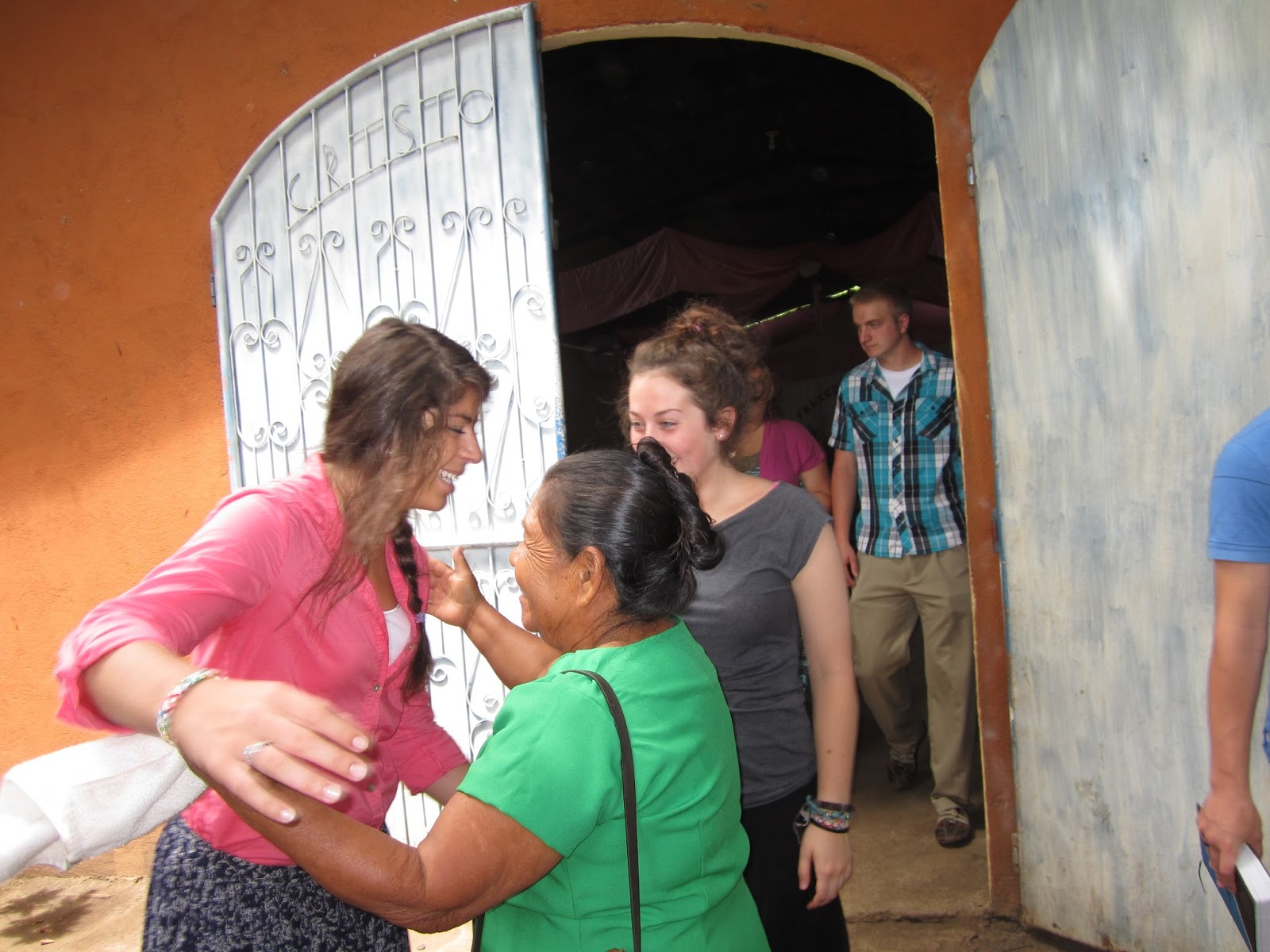
In fact she was the same girl who literally stopped the bus as we pulled away for the last time, pushed open the doors, climbed the steps and yelled, “Bet!  Bet!  Don’t leave me!”  I hugged her tightly, looked at her tears through mine, and promised her I’d return. 
Rosa was not in Terrencio earlier today, but I caught the back of her through the bus window.  We bumpily rode through the neighboring village she calls home (El Porvenir) on our way back to the hotel.  I’d know that confident, cocky stride anywhere.   Her now 12 year-old self seemed 
unchanged from afar, but I have no doubt she still rules the roost, as well as all the boys.  I can’t wait to hug her again tomorrow.
--------------
“Church” is different here.  It’s intense.  It’s moving and uplifting in ways which are indescribable unless you’re standing there, taking it all in amidst the excessively thick air.  Oh the air.  It simply does not flow inside that building, rendering its inhabitants sticky, smelly, nasty messes in a hurry.  Everything must be covered out of reverence to God, and we happily complied.  My sundress was soaked inside of 7 minutes, coming in second place only to a lightweight (or so I thought) cover-up counterpart.  I could not have cared any less.  Nor could any other soaking wet attendees.
The congregants move when they sing.  They feel when they respond.  They love with all their hearts. 
…All in Spanish. 
I understood roughly 20% at best of what was being said for 2 solid hours, yet, like last year, I was moved at my core.  Some things you don’t have to fully understand to just fully know.
"Where two or more are gathered..."  No matter the country, no matter the setting, no matter the language – we all worship the same God.  The One who knows us, and loves us anyway.


Saturday, June 15, 2013

Nicaragua - Day 2

Saturday, 6/15:  Nicaragua, Day 2-ish

The earlier post was really a recap of our travel day yesterday (Friday).  I have already officially lost track of all time, as the people of Nicaragua live extremely slow-paced lifestyles.  As we were riding this morning to Chinandega from Managua, I looked intensely out the bus windows, taking in the different surroundings. 
Mountainous terrain was in the background at every angle; people were closing in on mopeds and inside of overcrowded buses.  There are no driving rules here (which you know, makes me want to take the wheel) and I couldn’t quite reconcile where everyone was in a hurry to end up.  I think the locals have just gotten so used to driving like they’re starring in Frogger that it’s more of a routine pastime than an effort to arrive anywhere on time.
Families line the streets, sitting almost whimsically on plastic chairs in front of their Good Humor ice cream carts.  Some sell Coca-Cola, others sell hot dogs.  Well, presumably there are hot dogs inside the carts.  We didn’t stop.
The people just gather; that is their entire day.  There are no sales goals, there are no “plans,” there are no agendas.  It just is.
Often times in my life I have wondered if that’s a better way to live.  Realizing the definition of “better” is always subjective and relative, I have stopped trying to come to any conclusion.  But without question, different lifestyles are not only interesting, they are a necessity.  We are all products (or, at times, victims) of our environments and culture.  We are human.  And we adapt.  
In fact this group adapted so well today it made the leaders proud.  After an earthquake registering 6.5 prevented us from going to the ocean, we hunkered down at our hotel for the afternoon.  Our rooms are small, but completely functional and cozy. 
Once everyone unpacked, we hung out by the pool for the afternoon.  Friendly competition ensued both in and out of the water.  Mariam made the mistake of sighing, “I would do anything to work out right now,” so she and I did a speed pool-run ladder in the kiddie pool.  She enjoyed it so much that she decided to let me know later via a thorough euchre butt-kicking.
I’m enjoying the process of getting to know these kids.  Maddie is not only one of the smartest 15 year-olds I’ve ever met (quantum physics connoisseur AND a master hair-braider to boot), but she’s inquisitive and open to conversation.  Yeah…unplugging and talking all day was worth the dry contacts and every uninvited bug that nestled its way into my already affected heart.
The night ended with a group dinner and time of prayer.  We were each asked 3 questions and asked to journal about the answers.
What did you guys notice about the culture of Nicaragua?  What are the similarities and differences to the U.S.?
(As stated by Erik):  "The people here have so little and treat it as so much; sometimes, we are the exact opposite back home."
Amen, kiddo.  Amen.

Nicaragua - Day 1


Saturday, 6/15:  Nicaragua Day 1

Well, we are safely here.  And to think it only took 16 hours, one passport securely placed into checked luggage, and a queasy stomach flight casualty later.

Yet, all is well and everyone except the local roosters and I are asleep.  I forgot that Nicaragua is in the Mountain Time Zone, so we are two hours behind home on the clock, the same time on my internal clock, and on “Nicaraguan” time everywhere else.  The pace is slow; the people are friendly; the air is thick.

And I am very glad to be back.

We have a good group of kids traveling this year.  Collectively, we total 25.  I’m not sure what that registers in decibels, but suffice it to say, I didn’t talk much yesterday.  Instead, I observed.  I witnessed things that made me laugh, made me proud, and almost made me cry.  Group camaraderie does me in every time.  From the constant razzing to the constant support, it’s pretty cool when it happens effortlessly.

So after having successfully tracked down Rob’s passport in Indy as it circled a super clean conveyor belt on its way to the abyss down below, we grabbed a late lunch and waited to board the plane to Houston.   An on-time and smooth flight, our mission was underway.

Upon arriving in Houston, it was a mad dash to the food court – I had also forgotten how much High School kids can eat – and we boarded again en route to Managua.  That flight?  Not so smooth.  Todd managed to pull some strings and get me seated in the very last row on both flights.  I’m a smidge claustrophobic and would prefer making friends not on a plane, so couple that with my tired and a lot of self-talk was happening.

I am also not a fan of amusement parks under any circumstances, so when I lost my stomach in Demon- Drop-meets-that-horrid-Pirate-Ship-thing-style, I was only distracted by poor Alex throwing up 3 rows ahead.  Thankfully, Lauren handled it like a champ, promptly coming back with some remnants and an announcement of, “He’s fine, I’m getting him another bag and gave him some gum.”

When our plane finally landed as if we were getting pictures taken by family members standing on a bridge at the end of a log-flume ride, people started looking at me with a “What the ?” sort of look.  Clueless as to why, I look around.  And it’s not what I see that helps me understand the inquisition, it’s what I hear:  my kid in hereditarily, over-tired hysteria.  She’s screeching this sort of incomprehensible laugh, tears are flowing, shoulders are shaking.  Mariam’s eyeballs peer over the seat at me in an understood glance, and the rest of us start busting out in unison because you can’t not catch the contagion.

As we walk through the airport in Managua, we immediately paid our $10/each for a visa (Rob:  “Can the government really legally charge us to come here?”  Me:  “Three words.  Government, Nicaragua, ‘legal’.”  Just hang on to your passport.”).  I wasn’t sure if I’d remember the intricacies of the surroundings, but I did, and not much has changed in a year.  At least at the airport.

We were greeted by Alicia, a 25-year-old Food for the Hungry employee who is leading our group this year.  She and I talked on the bus ride from the airport to the center where we stayed last night – the place I sit now as I type.  Alicia has only been with FH for five months, but she is knowledgeable, friendly, and bright.  She graduated from college a few years back and is now studying Portuguese, which made me feel no bueno for my lack of Española.  Who knew those CD’s would take so long to listen to in between Petty and running down some dreams.

Miraculously, 25 tired and hungry travelers were still in decent moods as we arrived at the center around 11:00pm local time.  Our luggage was handed to us from atop the bus, and I self-talked my way out of picturing Aunt Edna, because Liv had already done the hysteria justice.  Wheeling in our bags, we smelled the chicken, vegetables, and papaya juice.

We ate, some showered, and some crashed.  And collectively, we slept.

Day 2 begins today as we travel to Chinandega – 2 ½ hours northwest.  Once we arrive, we will check into the hotel where we will stay through Thursday, gather into teams, and prepare for the remainder of our week.

We are all looking forward to meeting the people in El Porvenir, as we work to build not only relationships, but water filtration systems.  Oh, and hopefully play a little baseball.  Nothing breaks down language barriers faster than flying around makeshift bases in the pouring rain.

And nothing ends a blog post faster than 6 loud high school boys waiting to eat breakfast.


Thursday, June 13, 2013

Doth: A third person singular present tense of "do"

Tomorrow, 24 high school kids and 5 adults leave on a mission's trip.  Destination:  Nicaragua.

I have the privilege of tagging along again.  We were newbies last year, arriving in Managua, Nicaragua with only our charitable wit stowed visibly in our carry-ons, ostentatiously ready to "help." 

We were shuttled into various villages where the inhabitants wanted nothing more than to share time, love, and laughter.  Their faces lit up when we arrived merely because we were there, neither expecting nor desiring additionally anything.  These people live in a country known for its corrupt government, broken relationships, and spiritual poverty - thank goodness we know nothing about any of that - yet have an overwhelming appreciation for total strangers who naively think they are the ones helping.

This morning, I am thankful last year's visit confirmed the cliché "you will never be the same" is categorically true.  I am thankful that experience is the best teacher in all areas of life.  I am thankful God allows for head-shaking disbelief to wake us up when we need it most.

Speaking of, as I was mightily trying to wake up this morning with trough of coffee in hand, I read today's Proverb:

Ointment and perfume rejoice the heart:  so doth the sweetness of a man's friend by hearty counsel.  --Proverbs 27:9

The book of Proverbs is a collection of pithy sayings.  Yeah, I am also thankful for pithy.


Sunday, June 2, 2013

Supercalifragilistic Sunday

As this weekend winds down, I find myself loving every minute of its reflection. 

First, let me just say I love, love, love thoughtful people.  Caveat:  not the sickening over the top I expect something in return for disingenuously kissing your ass and feeding your already overinflated ego type "thoughtful" people.  I abhor those buttmunchers.

These kind:


Classy, direct lady.  Stands up for what she believes in, and calls out anyone with an obvious agenda.  Thanks, sister.  You dissipate my Catholic-girl guilt just by being you.

In typical dichotomous fashion, I'm pretty sure I not only constructed a brick wall on the fly this weekend, but tore one down as well.  I wish anyone the best of luck getting through what I throw up when it has anything to do with Liv.  I move mountains that make brick walls look like child's play for that girl - 16-year old pain in the arse that she is.  And never will that change.

Shockingly, slowly, maybe the carefully constructed wall which I erected two and a half years ago (ok, fine, in 1973) has come down.  Maybe...I think.  I'm somewhere between left and right, gliding back and forth like Oksana Baiul trying to greet that godforsaken little ball before it lands and I lose my turn.

As if that doesn't require enough Olympian-like maneuvering, apparently I am also supposed to give it a whirl without ever remembering how much Pong kicked my ass, or how big of a letdown Super Breakout turned out to be.  I suppose if I am going to continue to be defiant and "think," then the least I could do is remember that you had three turns to clear two screens of bricks before it was a total GAME OVER.

Speaking of games, last night's was certainly another love of my weekend.  D-Wade "ain't got nothin' more to say about his bum knee 'cuz that's all we been talkin' about for 2 months," and Fredo is sick of carrying that gimp and the pterodactyl who can't get anything done in the paint when he runs into a 7'2" brick wall.  Hey, Bosh...I know a girl who can help break you out of your slump.  See above when you're done hanging your head in voodoo hex formation.

Lastly, my day with Liv has been pretty great.  I took a break from writing a book proposal (fingers and eyes crossed) to make her breakfast when she awoke at lunch.  We talked about meaningful things, why people do what they do, who we allow to infiltrate our lives and those who, without question, don't deserve an ounce of our energy. 

As I type this, Liv is sitting right beside me, typing paragraphs four and five of her English paper - due tomorrow, duh - while critiquing the first three I wrote.  The three, mind you, I put together in an hour after never having read either book we are "linking the greater idea between."  She's staring at me now, after resolutely announcing "I'm done."  The shot clock takes longer to expire than that effort, but what the hell do I know? 

I'm just a thinker.

Um-diddle-diddle-um-diddleye.


Saturday, June 1, 2013

Tuesday, May 21, 2013

Misery

I received an email today from a friend asking how I'm doing now that the campaign has ended and indicating he misses my daily blog.  Someone misses my writing, I thought.

This afternoon I sent a text to my life-long friend of the same name - Beth, the Psychologist.  Yep, that is her profession.  Thank god it's her and not me.  Me, as a shrink, is too oxymoronic for any of us to bear.  She said, "You are funny, and your messages are a welcome break."

A funny writer.  Maybe.  An introspective pain in the ass.  Probably.  A lot of things...Who knows.

All I know with any certainty right now is that I'm drinking wine - a gift from someone I could go on about but promised not to (plus he has a lot of keys) - and remembering how much I enjoy this outlet, this respite from my funny, oxymoronic life. 

Hello, blog.  Hello, you.  Hello, Magnolia.  (He's touring now and only true fans or really <'ing> smart people will understand.)

Without a lot of editing effort, here's what's on my mind:  Misery.  Yes, you read me right.  The movie.  I am toying with the idea of a Paul Sheldon-like endeavor; writing as a profession.  While I'm not so sure the name of my protagonist will be "Misery Chastain," I am completely confident I could drum up some equally intriguing porn-pole-stripper meets librarian-stuffed-shirt-thick-glasses kind of name for a main character.  And I am equally, if not even more so sure that I could pull from past experiences to make for one heck of a forty-year plot line.

The movie was an instant four stars with me from its inception.  First, who doesn't think Stephen King is genius other than perhaps a few children plowing corn fields?  James Caan was brilliantly cast, and was only outshone by one Kathy Bates.  Dirty birdy she was...

Sure, Annie (I've been called worse) is an utter psychopath, but it's slightly endearing.  I mean, who has the balls to ever admit to being someone's "number one fan?"  I like it.  It's confident, bold, and direct.  She is knowledgeable about Paul's novels and can speak with both passion and intelligence on point.  Again, I like it.

Annie does, however, purport to disliking Paul's excessive swearing in his new novel.  @*#! that.

Favorite quote from the movie, you ask?  Yes, it's too obvious but I will answer you nonetheless as it is a MUST with me to walk away from every movie with a favorite line: 

"I have tried twice to be married and couldn't do it either time.  But, if you want me to take you away, to scare you or involve you or make you cry or grin, yeah.  I can.  I can bring it to you and keep bringing it until you holler uncle.  I am able.  I CAN."

Welp...time for me to make a phone call.  Maybe he will answer with:  "That's very sweet of you."